
October 8, 2026 by Spacer
Yes, potentially. People with well-controlled diabetes may be able to participate in commercial spaceflight on a case-by-case basis, but no universal medical standard currently guarantees eligibility. Diabetes-specific technologies such as continuous glucose monitors and insulin pens have been tested in space, while flying an actual passenger with diabetes remains an area of ongoing research.
For decades, the image of an astronaut was intrinsically linked to absolute physical perfection. During the Apollo and Space Shuttle eras, even minor health infractions were grounds for immediate disqualification. For career astronaut selection, NASA’s medical standards (OCHMO-STD-100.1A) currently disqualify candidates with Type 1 or Type 2 diabetes due to the strict necessity of mitigating mission-critical medical emergencies during long-duration, multi-billion-dollar operations.
However, the dawn of the commercial spaceflight era has fundamentally shifted the medical paradigm from strict categorical exclusion to risk-stratified, case-by-case evaluation. The Federal Aviation Administration’s Office of Commercial Space Transportation (FAA-AST), which oversees private flights in the U.S., relies heavily on an “informed consent” framework rather than universal medical disqualifications. While some proposed medical frameworks and aerospace literature have suggested HbA1c thresholds—such as <7.5% for selected individuals with well-controlled Type 2 diabetes—this is not a universal regulatory requirement. The commercial spaceflight industry is actively researching how chronic metabolic conditions could be safely managed in future missions.
Understanding the Risk: Suborbital vs. Orbital Spaceflight
Clearing a passenger for launch requires evaluating the specific mission profile. The aerospace medical community treats diabetes management vastly differently depending on the flight duration:
- Suborbital Flights: These last only a few minutes to a couple of hours. Short suborbital flights generally involve substantially less cumulative radiation exposure and logistical complexity than long-duration orbital missions, but they are not risk-free. The primary concerns are extreme G-forces, acute stress, and motion sickness, which can cause short-term glucose excursions.
- Orbital Flights: Staying in Low Earth Orbit (LEO) for days, weeks, or months introduces complex physiological adaptations. Passengers must manage fluid shifts, muscle unloading, sleep disruption, space food nutrition, and the viability of their medications in a sustained microgravity environment.
Launch and Reentry: Surviving Extreme Acceleration
During launch and reentry, passengers are subjected to severe hypergravity (G-forces). A critical aerospace medical question is whether the diabetic cardiovascular system can tolerate these extremes.
Centrifuge studies have shown that people with well-controlled medical conditions, including diabetes, can tolerate acceleration profiles representative of commercial suborbital flight, with experimental profiles reaching approximately +6.0 Gx and +4.0 Gz. No clinically significant adverse cardiovascular or physiological responses were observed during these centrifuge exposures.
However, tolerance depends heavily on the type and progression of the diabetes. For individuals with Type 2 diabetes, underlying complications—such as diabetic retinopathy, severe cardiovascular disease, or autonomic neuropathy—can impair the body’s ability to regulate blood pressure under high G-loads. Passing a standard pre-flight cardiovascular stress test (like a Bruce protocol treadmill test) is an important part of the assessment, but a comprehensive aerospace evaluation must specifically rule out advanced complications to ensure passenger safety.
The Microgravity Metabolic Shift
Once in orbit, the environment of weightlessness triggers profound physiological changes that directly impact glucose metabolism.
Muscle Unloading and Insulin Resistance
On Earth, postural muscles constantly burn glucose to keep the body upright. In space, mechanical loading vanishes. Research utilizing spaceflight data and bed-rest analogues demonstrates that this “muscle unloading” leads to rapid atrophy and significant metabolic changes compatible with insulin resistance. For a passenger with diabetes, these changes could alter insulin requirements, making close glucose monitoring and mission-specific treatment adjustments essential.
Cephalad Fluid Shift
Without gravity pulling fluids downward, plasma shifts toward the chest and head. Whether microgravity-related changes in tissue perfusion and fluid distribution significantly alter subcutaneous insulin absorption (e.g., from a thigh versus an abdominal injection) remains uncertain and requires further study.
Neuroendocrine Responses
Spaceflight can alter cortisol and catecholamine (adrenaline) responses, particularly during stressful phases such as launch, space adaptation, and landing. These neuroendocrine changes may influence glucose metabolism, although the magnitude and direction of the effect vary significantly between individuals and mission phases.
Space Nutrition and Glycemic Control
Space foods are highly processed and designed for long shelf life. Although sodium content has historically been a concern, NASA has substantially reduced sodium levels in modern space-food systems.
The immediate dietary challenge in orbit is Space Adaptation Syndrome (space motion sickness). Nausea, reduced appetite, and inadequate food intake are common in the first few days of flight. For an insulin-dependent passenger (Type 1 diabetes), illness combined with interrupted food intake while active insulin is in the system poses a severe risk of hypoglycemia. Conversely, any interruption in insulin delivery carries the acute risk of Diabetic Ketoacidosis (DKA).
Diabetes Hardware in Orbit: What Has Been Tested?
Historically, it was unknown how standard diabetes technology would function outside Earth’s atmosphere. Recent commercial missions have rapidly advanced our understanding—proving that the technology functions in space, even though an actual diabetic patient has not yet flown.
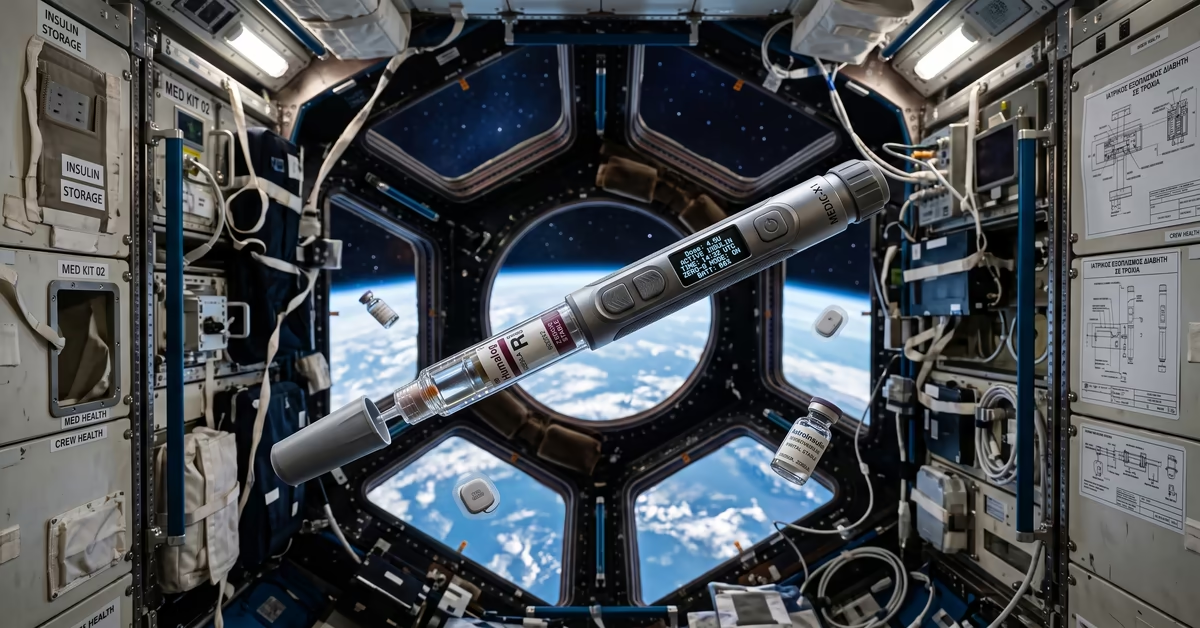
- Insulin Pens: A major milestone was achieved in 2024 during Virgin Galactic’s Galactic 07 suborbital mission, where researcher Tuva Atasever successfully tested the dispensing capabilities of commercially available insulin pens in microgravity. In 2025, Axiom Space’s Ax-4 “Suite Ride” initiative took this further, validating insulin pens aboard the International Space Station (ISS) and studying insulin stability in orbit.
- Continuous Glucose Monitors (CGMs): Commercial orbital missions—including Inspiration4, Polaris Dawn, Fram2, and Ax-4—have successfully utilized CGMs to track crew metabolism, showing that average glucose values for healthy crews remain in terrestrial ranges. However, CGMs measure interstitial glucose, not direct capillary blood glucose. Because fluid distribution, pressure, and tissue perfusion change in microgravity, there is a risk of physiological lag or sensor artifacts. This makes redundant glucose monitoring (such as confirmatory capillary finger-sticks) particularly important for missions involving insulin-dependent passengers.
- Insulin Pumps: Early experimental studies suggest that some insulin-delivery systems can function during microgravity, but commercially available insulin pumps are not yet universally qualified for operational human spaceflight. Fluid mechanics, bubble formation, and pump pressure dynamics in zero-gravity remain active areas of evaluation.
Emergency Protocols: Managing Hypoglycemia in the Void
Unlike an aircraft, a spacecraft cannot simply divert to the nearest hospital. Emergency return depends on the spacecraft, orbital configuration, weather, vehicle readiness, and the availability of a return vehicle.
Because medevac is not immediate, in-flight mitigation is paramount. A mission carrying an insulin-dependent participant would likely require redundant glucose monitoring, rapidly accessible carbohydrates, glucagon, and appropriate medical capability for severe hypoglycemia, with the exact medical kit determined by mission duration and vehicle capabilities.
Crucially, passengers must not suffer from hypoglycemia unawareness. The inability to recognize the early cognitive and physical signs of low blood sugar is a severe operational hazard, particularly during critical flight phases or emergency procedures where cognitive performance is mandatory.
The Final Frontier for All
The commercial spaceflight industry is beginning to demonstrate that some chronic metabolic conditions may be manageable in space, but diabetes remains an active area of medical research rather than an established category of spaceflight eligibility. As hardware validation continues and operational protocols mature, the prospect of managing diabetes in orbit moves steadily closer to reality.
Frequently Asked Questions
Can someone with Type 1 diabetes become a NASA astronaut?
Currently, no. NASA strictly disqualifies individuals with both Type 1 and Type 2 diabetes from their career astronaut selection process. The strict medical standards for government space agencies are designed to mitigate any risk of severe, mission-critical medical emergencies during long-duration orbital and deep-space missions.
Are commercial space tourism flights safe for people with diabetes?
Commercial space operators evaluate passengers on a case-by-case basis under an “informed consent” framework. While suborbital and orbital flights are never entirely risk-free, recent centrifuge studies show that people with well-controlled diabetes can physically tolerate the G-forces of launch. However, a comprehensive aerospace medical evaluation is required.
Can you take insulin to space?
Yes, but it remains an area of active research. Recent commercial missions, such as Virgin Galactic’s Galactic 07 and Axiom Space’s Ax-4, successfully tested the dispensing mechanisms of standard insulin pens in microgravity. While the hardware works, researchers are still studying how cosmic radiation affects the long-term chemical stability of insulin.
Do continuous glucose monitors (CGMs) work in zero gravity?
Yes, CGMs have been successfully used by healthy crew members on recent commercial missions like Inspiration4, Polaris Dawn, and Ax-4. However, because microgravity causes bodily fluids to shift, the interstitial fluid that CGMs measure can be affected. For this reason, redundant testing (like traditional finger-sticks) is recommended for insulin-dependent passengers.
How does microgravity affect blood sugar?
Being in a weightless environment causes rapid muscle unloading and atrophy, as your body no longer has to work against gravity. Because muscles are the primary site for glucose disposal, this unloading leads to metabolic changes that strongly mimic insulin resistance. Additionally, the stress of spaceflight can elevate cortisol levels, which also impacts blood sugar management.
Is an insulin pump safe to use in space?
Standard commercial insulin pumps are not yet universally qualified for human spaceflight. Microgravity alters fluid dynamics, meaning microscopic air bubbles in the pump’s reservoir won’t naturally rise to the top. While early experimental studies are promising, pump pressure dynamics in zero-gravity remain under active aerospace medical evaluation.
Sources
NASA Office of the Chief Health and Medical Officer (OCHMO):NASA Aerospace Medical Certification Standard (OCHMO-STD-100.1A) NASA OCHMO Standards
Federal Aviation Administration (FAA):Commercial Human Spaceflight Regulations & Guidance FAA Human Spaceflight
Virgin Galactic (Galactic 07 Mission – 2024 Virgin Galactic News / Galactic 07
Axiom Space (Ax-4 Mission / “Suite Ride” – 2025) Axiom Space Research & Suite Ride
Virgin Galactic (Galactic 07 Mission – 2024) Virgin Galactic News / Galactic 07
Aerospace Medicine and Human Performance (AMHP) PubMed – Acceleration tolerance in subjects with medical conditions
Microgravity, Muscle Unloading & Insulin Resistance NASA Technical Reports Server (NTRS) – Spaceflight and Insulin Resistance
Continuous Glucose Monitors (CGMs) Inspiration4 Spaceflight Medical Research (Nature/PubMed)
Insulin Pumps PubMed – Diabetes technology and insulin delivery in microgravity