
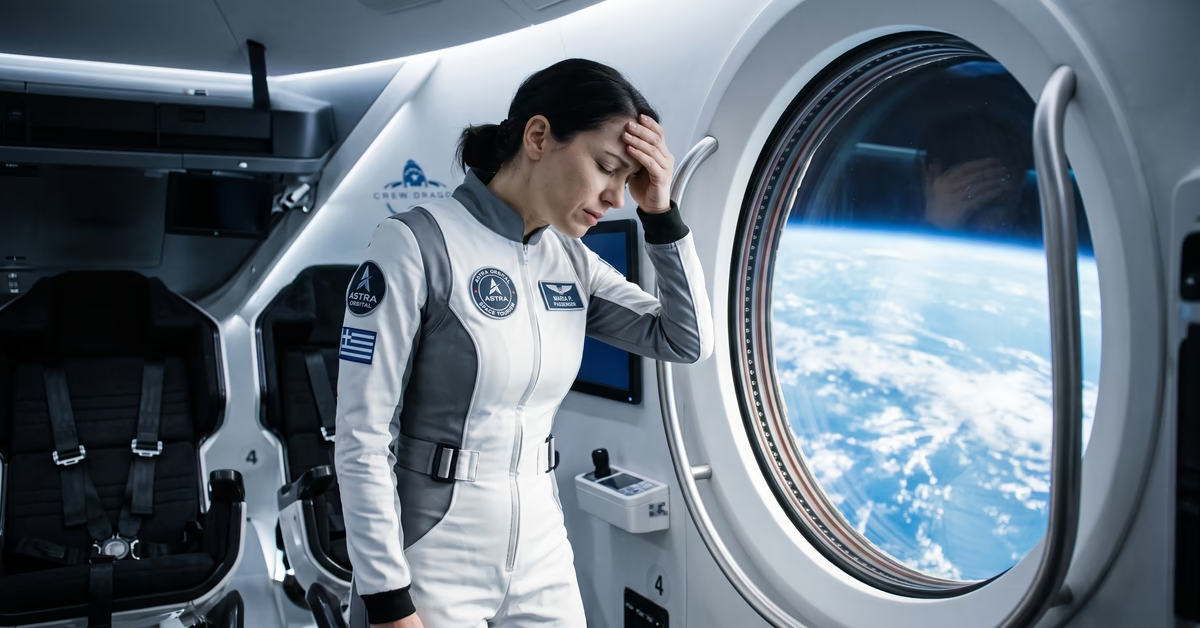
Imagine looking out the window of a commercial spacecraft, seeing the curvature of the Earth set against the black void of space, and feeling the ultimate freedom of weightlessness. You have paid a small fortune for this experience. Now imagine that instead of enjoying this once-in-a-lifetime view, you are desperately clinging to a sickness bag, battling a relentless wave of nausea, cold sweats, and dizziness.
If you are wondering whether you can get motion sickness in space, the answer is a resounding yes. According to NASA’s historical and recent data, **Space Motion Sickness (SMS) affects up to 73% of astronauts** during their first few days in orbit.
As space tourism transitions from a sci-fi dream to a commercial reality, understanding how the human body reacts to leaving Earth is no longer just for NASA flight surgeons. It is essential knowledge for anyone booking a flight to the final frontier. However, it is important to note that **most of our current medical data comes from highly trained professional astronauts**. How the average, untrained commercial space tourist will react is still a major area of ongoing medical research.
Here is the scientifically accurate truth about space sickness, why it happens, and how space medicine aims to keep future travelers safe.
Part 1: The Space Tourist’s Experience
In the medical community, this condition is formally known as **Space Adaptation Syndrome (SAS)** or Space Motion Sickness (SMS). While it shares some visual similarities with the seasickness or car sickness you might experience on Earth, SAS is a distinctly different and far more complex neurological event.
When you get car sick, your body is reacting to unpredictable motion—the bumps in the road or the rocking of a boat. In space, you don’t even need to be moving to feel ill. Simply turning your head to look at a fellow passenger can trigger a sudden and overwhelming bout of nausea.
What Does Space Sickness Feel Like?
The onset of SAS usually occurs within the first few hours of achieving weightlessness (microgravity). The symptoms range from mild discomfort to debilitating illness, typically manifesting as:
Stomach awareness:** A unique spaceflight term describing a hyper-awareness of your stomach contents. It is often the first warning sign before actual nausea hits.
Loss of appetite and lethargy:** A sudden disinterest in food and a feeling of profound exhaustion that makes astronauts want to simply float still in a dark corner.
Pallor and cold sweats:** The classic visual signs of motion sickness.
Sudden vomiting:** Unlike Earth-bound motion sickness, which usually builds up slowly with plenty of warning, space sickness can cause sudden, episodic vomiting.
The good news for future orbital space tourists is the timeline of neurosensory adaptation. **For the vast majority of space travelers, symptoms generally resolve within the first 2 to 3 days.** There is no magic switch that flips, but as your central nervous system slowly rewires itself to understand the new microgravity environment, the nausea fades away.
The “Garn Scale” of Space Sickness
To understand how unpredictable SAS can be, look no further than the “Garn Scale.” In 1985, U.S. Senator Jake Garn flew on the Space Shuttle Discovery. He experienced such a severe, incapacitating case of space sickness that his fellow crew members jokingly created the “Garn Scale” to measure SAS. Most astronauts only ever reach a fraction of a “Garn.” **His experience became a famous example of how difficult it is to predict who will experience severe space motion sickness.** Physical fitness, jet-fighter experience, or sheer willpower cannot predict who will succumb to it.
Part 2: The Science of Space Sickness (Why It Happens)
While the experience of space sickness is fundamentally a human discomfort, the underlying mechanism is a fascinating study of human biology trying to make sense of an alien environment.
The Sensory Conflict Theory
Your brain maintains balance and spatial awareness by constantly cross-referencing data from three primary systems: your eyes (visual), your muscles and joints (proprioceptive), and your inner ear (vestibular system).
On Earth, these systems are in perfect harmony. In space, this harmony is violently shattered, leading to what scientists call **Sensory Conflict** or **Neural Mismatch**. The modern literature suggests that space sickness is heavily driven by a specific conflict between the different sensors inside your inner ear.
Inside your vestibular system, there are tiny organs called **otoliths (the utricle and saccule)**. These organs contain microscopic calcium carbonate crystals (otoconia) embedded in a jelly-like membrane. On Earth, gravity constantly pulls down on this membrane, telling your brain exactly which way is “down.”
A common misconception is that in microgravity, these crystals break off and float around. That is incorrect. Instead, **the otoliths no longer provide the same gravity-related signals that the brain has learned to expect on Earth.** When you move your head in space, the mechanical stimulus sent to the brain by the otoliths is completely altered. Your brain receives a massive data conflict: your semicircular canals (which detect rotation) say your head is moving, but the otoliths fail to provide the expected gravity-related signals.
The Evolutionary Toxin Hypothesis
Why does this sensory confusion lead to vomiting? **One evolutionary hypothesis is that this profound sensory mismatch may resemble the kind of neural disturbance associated with neurotoxic poisoning, triggering an ancient protective response that includes nausea and vomiting.** Because humans did not evolve to travel in space, the brain’s hardwired logic might assume that if the eyes and the inner ear are reporting completely different realities, you must have ingested a neurotoxin that is causing hallucinations.
The Fluid-Shift Hypothesis
Complicating matters is the physiological fluid shift. On Earth, gravity pulls your bodily fluids down toward your legs. In space, **approximately 2 liters of fluid shift cephalad (upward into the chest and head).** This causes the famous “puffy face” look of astronauts.
While it is a well-documented physical change, there is also a **fluid-shift hypothesis** regarding space sickness. Some researchers propose that this massive upward shift of fluids alters the pressure dynamics within the inner ear and the cranium, potentially contributing to the onset or severity of Space Motion Sickness.
Part 3: Suborbital vs. Orbital Tourism (A Crucial Distinction)
When discussing space tourism, we must separate the experience into two entirely different categories, as the medical risks vary wildly between them.
1. Suborbital Flights (e.g., Blue Origin, Virgin Galactic)
These flights typically provide only a few minutes of microgravity during a short suborbital flight.** Because the flight is so brief, suborbital tourists generally have less time to develop the classic, multi-day Space Adaptation Syndrome.
However, this does not mean they are immune to severe nausea. Suborbital passengers undergo extreme G-force transitions—going from high-G acceleration, to sudden weightlessness, and back to high-G deceleration. **These rapid transitions between high acceleration and microgravity can provoke nausea, disorientation, and motion-sickness symptoms, even during a very short flight.
2. Orbital Flights (e.g., SpaceX Crew Dragon, Axiom Space)
These are multi-day or multi-week stays on orbital spacecraft or space stations. Orbital tourists will face the full brunt of classic Space Motion Sickness. **They must expect that the first 2 to 3 days of their expensive vacation may be spent feeling quite ill** while their neurosensory system slowly adapts to the continuous microgravity environment.
Part 4: The Real Operational Risks
For a commercial space tourist on a luxury orbital hotel, vomiting might just seem like an expensive inconvenience. But from the perspective of aerospace medicine, Space Adaptation Syndrome presents serious operational risks.
1. The Aspiration Hazard During Launch and Re-entry
The most critical times during any spaceflight are launch and re-entry. **During launch and re-entry, passengers are tightly restrained and subjected to significant acceleration forces.** Depending on the vehicle and mission profile, they may also be wearing protective or pressure-support equipment.
**If vomiting occurs inside a helmet or suit system, it can become a serious airway and visibility hazard.** Because the passenger is pinned down by G-forces and cannot easily clear their airway, this can obstruct the airway, impair vision, and in extreme circumstances become life-threatening. NASA has strict suit design requirements specifically to mitigate this scenario.
2. Dehydration and Emergency Egress
**Repeated vomiting, combined with the physiological fluid and electrolyte changes of spaceflight, can increase the risk of dehydration and weakness.** Furthermore, severe motion sickness causes profound lethargy and cognitive fog. In the event of an onboard emergency (such as a fire or depressurization), a passenger suffering from severe SAS may be physically and mentally incapable of unbuckling their harness or following rapid evacuation procedures.
3. Extravehicular Activity (EVA) Restrictions
While commercial tourists are not routinely performing spacewalks yet, the standard operational protocol is clear: **Critical tasks, including EVAs, are generally delayed until the crew member has adapted and is capable of performing safely.** Having an astronaut vomit inside an Extravehicular Mobility Unit (EMU) helmet while floating outside the spacecraft is a highly dangerous emergency.
Part 5: Medical Countermeasures and Prevention
Because Space Adaptation Syndrome is such a significant risk, space medicine experts rely on specific countermeasures to protect space travelers.
Pharmacological Solutions (Medication)
**Once severe nausea or vomiting begins, oral medication may be less reliable** because vomiting and altered gastrointestinal function can interfere with administration and absorption.
**Promethazine, particularly when administered intramuscularly, has been one of the most widely used and extensively studied treatments for severe space motion sickness in NASA experience.** It provides rapid, highly effective relief. Other medications, including meclizine and ondansetron, have also been investigated or used, depending on the mission and clinical circumstances.
Behavioral and Investigational Training
Medication is only part of the strategy. Space tourists will also rely on behavioral adaptations:
* **Head movement restriction:** The most critical rule for the first few days in orbit is to limit provocative activities. Moving the head slowly, especially avoiding pitching motions, prevents aggressive agitation of the confused vestibular system.
* **Investigational Training:** **Some forms of preflight sensorimotor and adaptation training have been studied for decades, while newer technologies remain investigational.** This includes exploring the use of advanced virtual reality and centrifuge training to safely expose passengers to sensory conflict on Earth, aiming to help their brains build a tolerance before launch day.
The Verdict for Future Space Tourists
Can you get motion sickness in space? Absolutely. For orbital travelers, Space Adaptation Syndrome is a well-documented risk, while the experience of commercial passengers—particularly on short suborbital flights—remains less well characterized. By understanding the medical science behind space sickness, future space tourists can better understand the risks and the countermeasures designed to keep them safe as they conquer the final frontier.
Sources
NASA Technical Reports Server (NTRS) – Space Motion Sickness Updates: https://ntrs.nasa.gov https://ntrs.nasa.gov
NASA Technical Reports Server (NTRS) – Space Motion Sickness Updates: https://ntrs.nasa.gov/](https://ntrs.nasa.gov
NASA Human Research Program (HRP) – Space Adaptation: https://www.nasa.gov/hrp](https://www.nasa.gov/hrp
European Space Agency (ESA) – The Human Body in Space: https://www.esa.int/Science_Exploration/Human_and_Robotic_Exploration/Space_medicine https://www.google.com/search?q=https://www.esa.int/Science_Exploration/Human_and_Robotic_Exploration/Space_medicine
PubMed – Vestibular Otoliths and Sensory Conflict in Microgravity: https://pubmed.ncbi.nlm.nih.gov/(https://pubmed.ncbi.nlm.nih.gov
Space Medicine Association – Commercial Spaceflight Medical Considerations: https://spacemedicineassociation.org https://spacemedicineassociation.org/
Frequently Asked Questions
What is Space Adaptation Syndrome (SAS)?
Space Adaptation Syndrome (SAS), also known as Space Motion Sickness (SMS), is a condition experienced by space travelers as their bodies transition into microgravity. It causes symptoms like “stomach awareness,” loss of appetite, lethargy, cold sweats, and sudden vomiting.
How common is motion sickness in space?
It is extremely common. According to NASA data, Space Motion Sickness affects up to 73% of astronauts during their first few days in orbit. Physical fitness or flight experience does not predict whether you will experience it.
How long does space sickness last?
For the vast majority of orbital space travelers, SAS symptoms resolve naturally within the first 2 to 3 days. During this time, the brain and central nervous system slowly adapt to the continuous microgravity environment.
What causes Space Motion Sickness?
The primary cause is believed to be “Sensory Conflict.” In microgravity, the otoliths in your inner ear no longer provide the gravity-related signals your brain expects. This creates a severe mismatch between what your eyes see and what your inner ear feels. Researchers also hypothesize that the upward shift of bodily fluids in space may contribute to the symptoms.
Will I get space sick on a short suborbital flight?
Even though suborbital flights (like those offered by Blue Origin or Virgin Galactic) only provide a few minutes of microgravity, passengers can still experience motion sickness. The rapid transitions between high-G acceleration and sudden weightlessness can provoke sudden nausea and disorientation.
Can I take normal motion sickness pills in space?
Standard oral motion sickness pills are often less reliable in space. Once severe nausea begins, altered gastrointestinal function and vomiting make oral pills difficult to absorb. For severe cases, space medicine experts frequently rely on Promethazine administered via intramuscular injection for rapid relief.
Why is vomiting considered a severe hazard during space travel?
While vomiting is unpleasant, it becomes a dangerous operational risk if it happens during launch, re-entry, or a spacewalk. If a passenger vomits inside a protective suit or helmet while restrained under high G-forces, the fluid cannot be easily cleared. This can obstruct the airway, impair vision, and become a life-threatening emergency.
How do astronauts prevent space sickness?
Along with medication, a critical behavioral countermeasure is head movement restriction. Astronauts are trained to limit provocative activities and move their heads slowly during their first few days in space to avoid aggravating the vestibular system. Preflight sensorimotor training is also being investigated for future space tourists.