
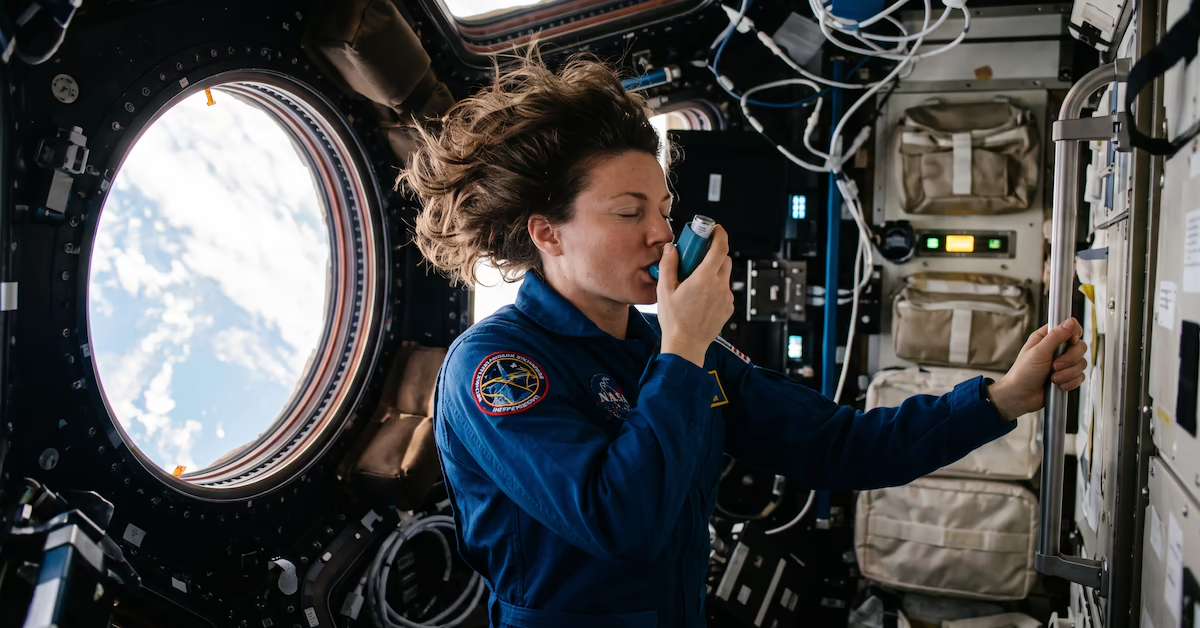
A generation ago, an asthma diagnosis permanently closed the door to spaceflight. Today, the rise of private space tourism is shifting the medical landscape. If you are asking, can I go to space with asthma?, the short answer is yes. However, the reality of making that trip depends entirely on who is flying the rocket and how well your condition is managed.
Government agencies like NASA demand near-perfect physiological baselines for long-duration missions. In contrast, commercial spaceflight companies evaluate passengers based on risk mitigation for short suborbital trips. To understand whether an individual with respiratory issues can safely leave the atmosphere, we have to look directly at aerospace medical standards, zero-gravity physiology, and the mechanics of airway management in orbit.
Table of Contents
Has Anyone with Asthma Been to Space?
When searching for precedents, people often wonder if there are any known astronauts with asthma. The medical records of career astronauts are strictly confidential. Because of this, space agencies do not publicly list crew members who have managed specific chronic diseases.
However, aerospace medical literature and declassified screening processes show that respiratory conditions are not absolute historical barriers, provided they meet specific criteria.
Can You Be an Astronaut with Childhood Asthma?
A frequent question from young applicants is whether a history of childhood asthma ruins their chances. For national agencies, active, persistent asthma that requires daily medication is a disqualifying condition. A severe asthma attack during a high-G launch or inside a spacesuit is a life-threatening emergency.
Yet, a history of childhood asthma is not an automatic rejection. Many applicants, including military pilots, have successfully secured a military pilot asthma waiver for space. To get this waiver, candidates typically must prove they have been symptom-free and off all asthma medications for several years. They must also pass rigorous pulmonary function tests, showing normal Forced Expiratory Volume (FEV1) and Forced Vital Capacity (FVC) without the use of bronchodilators.
Medical Rules: NASA Asthma Waivers & FAA Guidelines
The divide between government astronauts and private citizens comes down to the mission profile. A NASA astronaut spends six months on the International Space Station (ISS) doing physically demanding spacewalks. A commercial spaceflight participant spends a few hours in a capsule. The medical rules reflect this difference.
The NASA Asthma Waiver and Military Pilot Rules
NASA evaluates medical exemptions through its Aerospace Medical Board (AMB). The guidelines for these exemptions are detailed in the agency’s official Waivered Health Conditions document (OCHMO-MTB-002).
According to NASA’s standards, candidates with a history of certain pulmonary conditions or sensitivities might receive a waiver if the condition does not impact their operational performance. However, active asthma requiring systemic medication remains a primary disqualifying factor under baseline health standards (OCHMO-STD-100.1A). The agency evaluates the risk of a medical event occurring where immediate return to Earth is impossible.
FAA Spaceflight Participant Asthma Guidelines
Commercial spaceflight operates under entirely different rules. Rather than demanding physical perfection, private operators use a risk mitigation matrix.
The industry standard for evaluating private citizens is ASTM F3568, titled Standard Guide for Medical Qualifications and Screening of Space Flight Participants. A demographic study published in the National Institutes of Health (NIH) database comparing NASA astronauts to commercial participants explicitly references this standard.
Under ASTM F3568, an individual with mild, well-controlled asthma can receive medical clearance. Operators assess the statistical probability of the passenger suffering an incapacitating attack during the high-stress phases of flight. If baseline lung function is normal and the passenger has not required recent emergency room visits, they are generally cleared to fly.
Does Zero Gravity Help Asthma? The Science of Breathing in Space
A common misconception is that floating in a weightless environment relieves pressure on the lungs. People frequently search to find out, does zero gravity help asthma? The physiological reality is quite the opposite.
Is Breathing Easier in Space?
Breathing is not necessarily easier in space. On Earth, gravity pulls bodily fluids downward into the legs. In microgravity, this fluid shifts upward into the chest and head. This phenomenon, known as a cephalad fluid shift, is heavily documented in NASA’s Spaceflight Experience and Medical Care briefings (OCHMO-TB-033).
This fluid shift causes facial puffiness, nasal congestion, and increased blood volume in the pulmonary vessels. For an asthmatic, the increased fluid pressure in the chest wall can mildly reduce lung volume and make the airways feel more restricted. While a healthy astronaut adapts to this within a few days, an individual with reactive airways might experience heightened discomfort.
ISS Air Quality and Asthma Risks
The environment inside a spacecraft presents its own set of triggers. Spacecraft use Controlled Environmental Life Support Systems (ECLSS) that constantly recycle the cabin air.
While HEPA filters onboard the ISS remove bacteria and large particles, the cabin air is exceptionally dry, which is necessary to prevent condensation from damaging electronics. Dry air is a potent trigger for asthma. Furthermore, floating particulates, dead skin cells, and ambient dust do not settle on the floor in microgravity. They remain suspended in the breathing zone, increasing the likelihood of inhalation.
The Future Threat: Lunar Dust and Moon Asthma
As humanity looks toward returning to the Moon, a new respiratory threat has emerged. Research by the European Space Agency (ESA) and NASA’s Lunar Airborne Dust Toxicity Advisory Group (LADTAG) highlights the extreme danger of lunar regolith.
Moon dust is not like dust on Earth. Without wind or water to erode it, the particles remain jagged, glassy, and highly abrasive. Inhaling these sharp particles causes severe lung irritation. For an astronaut with asthma, exposure to lunar dust inside a habitat could trigger catastrophic airway inflammation, a concept researchers sometimes refer to as “Moon asthma.”
Treating an Asthma Attack in Space (Medications & Logistics)
If a commercial space tourist with asthma goes to space, they must be prepared to manage their condition independently. Commercial suborbital flights do not carry advanced life-support paramedics or doctors on board.
How Do Asthma Inhalers Work in Zero Gravity?
If you need to use an asthma inhaler in space, the physics of microgravity alter how the medication reaches your lungs. Research by aerosol physiology experts, such as Dr. Chantal Darquenne, has analyzed aerosol deposition in microgravity.
The mechanics depend on the device. Standard Metered-Dose Inhalers (MDIs) use a pressurized chemical propellant to push the medicine out. These work perfectly fine in a vacuum or in zero gravity because they rely on internal pressure.
However, the way the medicine settles inside the lungs changes. On Earth, gravity helps pull the aerosolized drug down into the lower respiratory tract. In space, deposition relies purely on the airflow of your breath and diffusion. Studies show that aerosols actually deposit more evenly across the lungs in microgravity, which means the inhaler remains highly effective.
Can You Bring an Albuterol Inhaler to Space?
For commercial passengers, bringing an albuterol inhaler to space is generally permitted, provided it is declared and approved by the company’s flight surgeon. Operators want passengers to have access to their rescue medications.
Passengers must demonstrate they can physically operate the inhaler while strapped into their seats and wearing a pressure suit. Since the G-forces during launch and re-entry compress the chest and make inhaling deeply difficult, passengers are trained to use their medication during the weightless coast phase if necessary.
Frequently Asked Questions
Can people with asthma go to space?
Yes. Individuals with well-controlled asthma can participate in commercial space tourism. Government agencies like NASA, however, typically disqualify candidates with active asthma due to the physical demands of long-duration missions.
What medical conditions disqualify you from going to space?
For government astronauts, disqualifying conditions include active asthma, untreated hypertension, severe heart disease, psychiatric disorders, and a history of seizures. Commercial flights have fewer absolute disqualifications and rely on individual risk assessments.
Can you take prescription medication in space?
Yes. Astronauts regularly take prescription medications in space for sleep, nausea, and minor pain. Commercial spaceflight participants can bring approved prescription medications, including rescue inhalers, provided the flight surgeon clears them.