
On Earth, gravity creates a hydrostatic pressure gradient that strongly influences the distribution of blood throughout the body, particularly when we are upright. When a spacecraft enters microgravity, the hydrostatic forces that normally shape blood distribution are greatly reduced. To study this phenomenon, researchers rely on actual spaceflight data alongside sophisticated ground-based analogues like -6° Head-Down Tilt (HDT) bed rest, dry immersion, and parabolic flights. As space tourism transitions into a commercial reality, understanding how cerebral hemodynamics adapt in weightlessness has become one of the most critical frontiers in aerospace medicine.
The Balance of Blood Flow: Active Arterial Autoregulation
Importantly, microgravity does not simply cause the brain to receive an uncontrolled surge of blood. Cerebral blood flow is highly regulated by changes in arterial pressure, cerebrovascular resistance, ambient carbon dioxide (CO2) levels within the spacecraft, and intrinsic autoregulatory mechanisms.
Within hours of entering microgravity, roughly 2 liters of fluid are redistributed from the lower body toward the chest and head, creating the classic “puffy-face, bird-legs” appearance. However, continuous Doppler ultrasound monitoring during parabolic flights has shown that the brain actively protects itself from this fluid shift. Blood flow velocity in the Middle Cerebral Artery (MCA) and the Common Carotid Artery (ACC) remains remarkably stable in weightlessness. The brain achieves this by constricting pre-capillary sphincters to increase vascular resistance and prevent dangerous hyperperfusion (excessive arterial inflow).
The Cephalad Fluid Shift
Interactive: Click to observe blood flow direction and fluid redistribution.
Earth (1G): Gravity pulls fluids downwards, maintaining a normal hydrostatic gradient towards the legs.
The Vulnerable Posterior Circulation and Space Motion Sickness
While the brain’s anterior circulation is robustly defended, recent studies have uncovered a heterogeneous response across the cerebral vasculature during early microgravity exposure.
While the internal carotid arteries remain hemodynamically stable, the vertebral arteries—which supply the brain’s posterior circulation—experience a significant decrease in flow velocity. This anatomical distinction is critical: the posterior circulation feeds the brainstem, cerebellum, and occipital lobe. Because these regions govern balance, autonomic control, and spatial orientation, this localized drop in perfusion is directly linked to the dizziness and space motion sickness frequently experienced during the first days of spaceflight.
Why the Body Purges Fluid: Cardiovascular Deconditioning
When the massive headward fluid shift occurs, stretch receptors in the heart and major blood vessels are “tricked” into perceiving that the body is dangerously over-hydrated.
In response, the kidneys initiate rapid diuresis, permanently reducing total plasma and blood volume by 15–20% to normalize upper-body pressures. Concurrently, because the cardiovascular system no longer pumps against gravity, it undergoes cardiovascular deconditioning. The heart muscle loses mass and adopts a more spherical shape, while blood vessels lose their muscular constrictive tone. This creates a deeply adapted “space-type equilibrium” that becomes problematic only upon return to Earth.
Intracranial Pressure and SANS
The redistribution of fluids toward the head alters intracranial pressure (ICP) and cerebrospinal-fluid dynamics, contributing to the development of Spaceflight-Associated Neuro-ocular Syndrome (SANS). Astronauts spending extended periods in orbit have exhibited distinct structural changes to the eye, including:
- Swelling of the optic disc.
- Flattening of the posterior globe (the back of the eyeball).
- Hyperopic (farsighted) vision shifts.
Recent spaceflight data confirms that the elevation in ICP is not caused by a surge in arterial inflow, but rather by impaired drainage. The extra fluid volume reaches the cerebral capillary bed but cannot efficiently exit, structurally altering the eye over time.
The Venous Bottleneck: Stagnation and Retrograde Flow
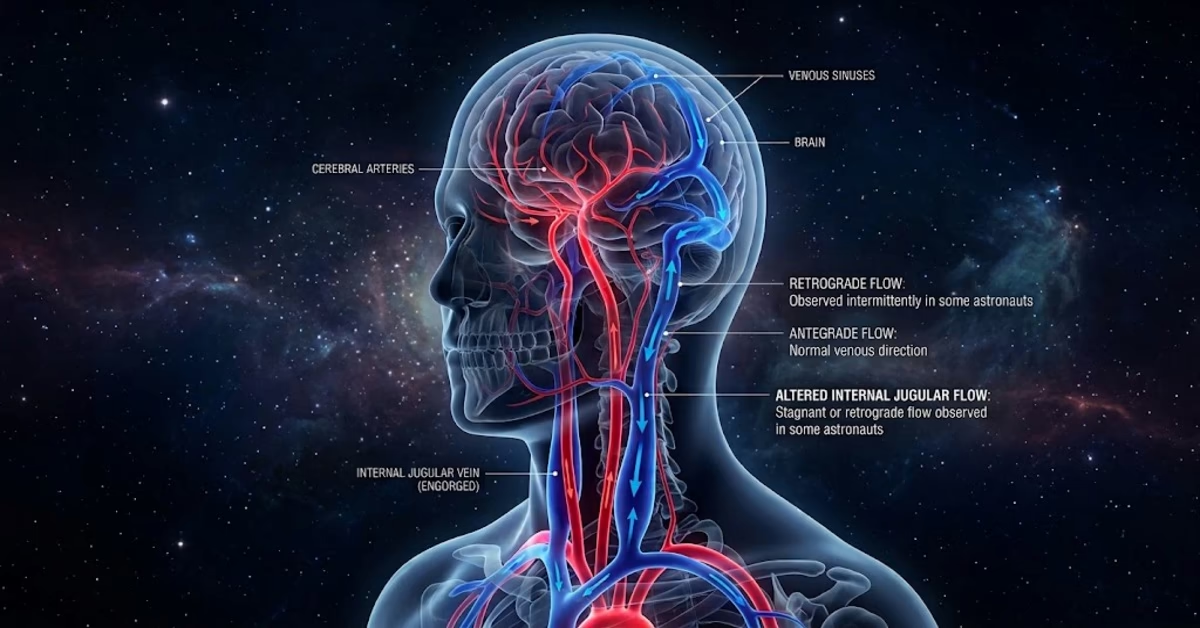
While arterial delivery is safely regulated, venous drainage in microgravity becomes a dangerous bottleneck.
In a landmark 2019 study of 11 ISS crew members, researchers discovered that the internal jugular veins become markedly distended. The mean left internal jugular cross-sectional area expanded from 9.8 mm² before flight to an astonishing 70.3 mm² during flight.
Furthermore, ultrasound revealed periods of stagnant or even retrograde (backward) flow in the internal jugular vein. This loss of steady venous drainage frequently results in spaceflight-induced headaches and introduces severe cardiovascular risks. During the 2019 study, one astronaut developed an occlusive internal jugular vein thrombus and required anticoagulation while in orbit.
To combat this bottleneck, the European Space Agency’s “Drain Brain” investigation utilized non-invasive strain-gauge plethysmography (specialized neck collars) to measure venous outflow. Researchers are actively investigating whether respiratory pumps (timed breathing exercises) and muscular contractions can serve as countermeasures to manually pull stagnant venous blood back to the heart.
Implications for Commercial Space Tourism
Professional astronauts are selected from a highly screened population, but commercial space tourism introduces a much wider range of pre-existing cardiovascular profiles to these extreme physiological shifts.
- Suborbital Flights: During brief suborbital profiles, passengers experience rapid transitions between hypergravity (ascent/reentry) and microgravity. Upon returning to Earth’s gravity, the combination of reduced blood volume (plasma loss) and atrophied blood vessels causes blood to pool heavily in the legs. This severely reduces cerebral perfusion, resulting in orthostatic intolerance (severe dizziness or fainting).
- Orbital Tourism: For multi-day missions, prolonged venous stagnation becomes the primary concern. Passengers with established risk factors for venous thromboembolism (VTE) face an elevated, though still unquantified, risk of thrombosis.
To manage these hemodynamic shifts, aerospace medicine utilizes countermeasures such as Lower Body Negative Pressure (LBNP) devices, which apply subatmospheric pressure to draw fluids back toward the legs. Future commercial missions will require individualized medical screening and, depending on flight duration, tailored preventive strategies—such as specialized breathing protocols and thrombotic risk management—to ensure the cerebral health of civilian space travelers.
Sources & Scientific References:
- Cerebral Autoregulation & MCAv (Parabolic Flights): Transient cerebral blood flow responses during microgravity — https://www.sciencedirect.com/science/article/abs/pii/S221455242030016X
- Hemodynamics & Neuronal Activity (CVCi & Autoregulation): PubMed — https://pubmed.ncbi.nlm.nih.gov/30741333/
- Plasma Volume Loss, Deconditioning & Orthostatic Intolerance: Cardiovascular Health in Microgravity (NASA) — https://www.nasa.gov/missions/station/cardiovascular-health-in-microgravity/
- Posterior Circulation Vulnerability (Vertebral Artery & Space Motion Sickness): EurekAlert / Space: Science & Technology — https://www.eurekalert.org/news-releases/1140968
- Arterial vs. Venous Outflow (COSPAR 2024 / Carotid Stability): Harvard ADS — https://ui.adsabs.harvard.edu/abs/2024cosp…45..384S/abstract
- Headaches, Strain-Gauge Plethysmography & Respiratory Pumps: Space station investigation goes with the flow (NASA/ESA) — https://phys.org/news/2015-10-space-station.html
- Ground-Based Analogues & General Hemodynamics Review: PMC / Med Sci Monit — https://pmc.ncbi.nlm.nih.gov/articles/PMC7814510/
Frequently Asked Questions
Why do astronauts get “puffy faces” in space?
In microgravity, the hydrostatic pressure gradient created by Earth’s gravity is greatly reduced. This causes roughly 2 liters of fluid to redistribute from the lower body toward the chest and head, leading to the classic “puffy-face, bird-legs” appearance.
Does blood flow to the brain increase in zero gravity?
Microgravity does not cause an uncontrolled surge of blood to the brain. While fluids shift upward, cerebral arterial blood flow remains highly regulated by factors like arterial pressure, cerebrovascular resistance, and carbon dioxide levels. The primary issue is not how blood reaches the brain, but how venous blood drains away from it.
Can space travel damage your eyes?
Yes, extended spaceflight can affect vision. The headward fluid shift may alter intracranial and cerebrospinal-fluid pressures, contributing to Spaceflight-Associated Neuro-ocular Syndrome (SANS). Symptoms include optic disc swelling, flattening of the back of the eyeball, and farsighted vision shifts.
Is it true that blood can flow backward in space?
Yes. A 2019 study of 11 ISS astronauts found that the internal jugular veins can become significantly distended. In some cases, ultrasound revealed stagnant or even retrograde (backward) venous flow in the internal jugular vein due to the altered pressure environment.
Can you get a blood clot in space?
It is possible. The stagnant venous flow observed in some astronauts alters normal cerebral drainage. During a 2019 ISS study, an astronaut developed an occlusive blood clot in their internal jugular vein and was treated with anticoagulants in orbit.
What happens to your blood pressure when returning to Earth?
During reentry and upon returning to Earth’s gravity, fluid rapidly shifts back to the legs. This sudden redistribution can temporarily reduce cerebral perfusion, leading to orthostatic intolerance—meaning passengers might experience severe dizziness or fainting upon standing.
Will space tourists need to take blood thinners?
Not necessarily. While astronauts have been treated for clots in orbit, commercial passengers will undergo individualized medical screening. Future orbital missions may develop tailored preventive strategies depending on emerging medical evidence and a passenger’s specific thrombotic risk factors.
Sources
JAMA Network Open (2019) Assessment of Jugular Venous Blood Flow Stasis and Thrombosis During Spaceflight by Karina Marshall-Goebel, Steven S. Laurie, Brandon R. Macias, et al. This peer-reviewed study documents the landmark ultrasound findings of stagnant flow, retrograde flow, and the first recorded internal jugular vein thrombus aboard the International Space Station. https://doi.org/10.1001/jamanetworkopen.2019.15011
npj Microgravity / Nature (2020) Spaceflight associated neuro-ocular syndrome (SANS) and the neuro-ophthalmologic effects of microgravity: a review and an update by Andrew G. Lee, Thomas H. Mader, C. Robert Gibson, et al. The definitive medical review detailing how cephalad fluid shifts elevate intracranial pressure and alter optic nerve structure during prolonged missions. https://doi.org/10.1038/s41526-020-0097-9
NASA Human Research Program (HRP) Evidence Report: Risk of Cardiovascular Adaptations Contributing to Adverse Mission Performance and Health Outcomes. NASA’s official clinical documentation detailing the mechanics of the “puffy-face, bird-legs” syndrome, loss of hydrostatic gradients, and countermeasures like Lower Body Negative Pressure (LBNP). https://humanresearchroadmap.nasa.gov/Evidence/reports/CV.pdf
Aerospace Medicine and Human Performance (AsMA) Medical Guidelines for Space Passengers. The Aerospace Medical Association’s official clinical recommendations outlining the cardiovascular risks of orthostatic intolerance, G-force transitions, and screening requirements for commercial space tourism participants with pre-existing conditions. https://www.asma.org/asma/media/asma/Travel-Publications/Med-Guidelines-Space-Passengers-II.pdf
The Journal of Physiology Impact of microgravity on the human cerebral circulation. A comprehensive analysis of how arterial delivery and venous return adapt to weightlessness, detailing the exact mechanisms of the venous bottleneck in the brain. https://doi.org/10.1113/jphysiol.2007.136754